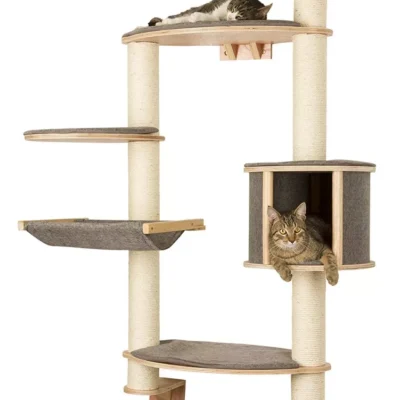
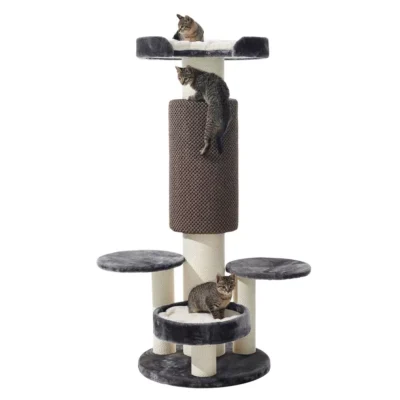
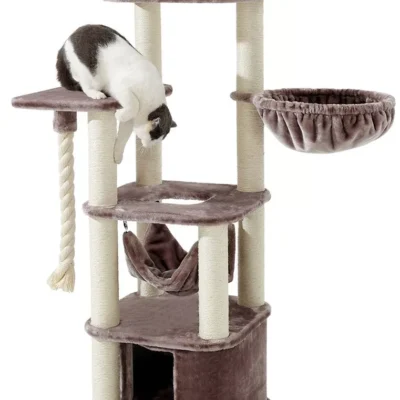
How to Choose the Best Cat Tree for a Large Cat: Complete Buying Guide
The best cat tree for a large cat is one that is stable, spacious and genuinely designed around the size and movement of the cat using it.
Height matters, but it is only one part of the equation. Base size, platform dimensions, scratching-post strength, sleeping space and the route between levels can make the difference between a tree your cat loves and one they barely use.
Compare at a glance
All measurements are in centimetres. On a phone, swipe the table sideways to compare.
Three models listed in stock when checked
What matters
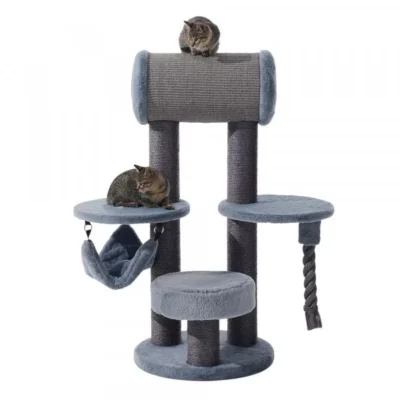
Kerbl Toni XL
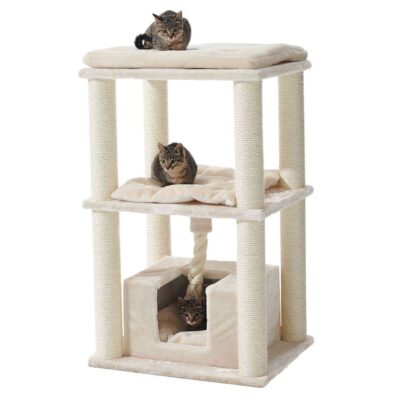
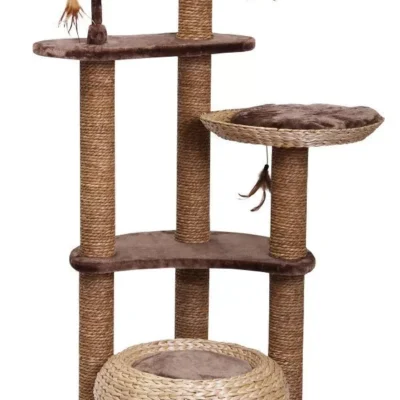
Nobby Zada, cream
Canadian Corner Coon, cream
Listed price
£99
£170
£269.54
Height
92
145
140
Base footprint
58 × 58
50 × 50
65 × 55
Post diameter
20
9
15
Published sleeping surface
50 × 47
Confirm usable bed and hammock dimensions
Top bed: 60 × 50; nest: Ø45
Main reason to consider it
Broad bed on a lower tree
Several resting levels; smaller base
Wide top bed; corner arrangement
Main trade-off
One main resting bed
Thinner posts; less complete bed measurements
Larger base than the Zada
Dimensions describe the listed base or component; they are not guaranteed internal sleeping measurements or the complete assembled clearance. Prices and stock can change—check the product page before ordering.
01 / Lower height · Under £100
Kerbl Toni XL
£99 Listed in stock when checked
A straightforward choice if you want a substantial scratching post and one broad bed, without a tall arrangement of platforms. Its 92cm height makes it the lowest tree in this comparison.
The removable cushion and bed also give you a practical cleaning option: follow the separate care instructions for each component.
Check before buying: this is not a multi-level climbing tower. A lower overall height does not automatically mean easy access for a cat that struggles to jump.
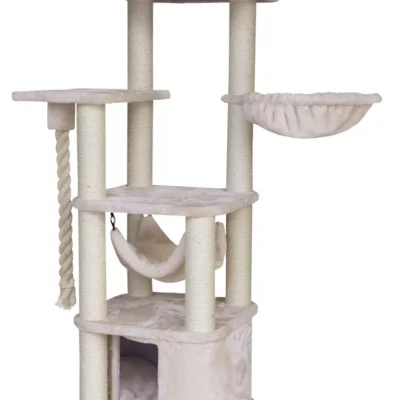
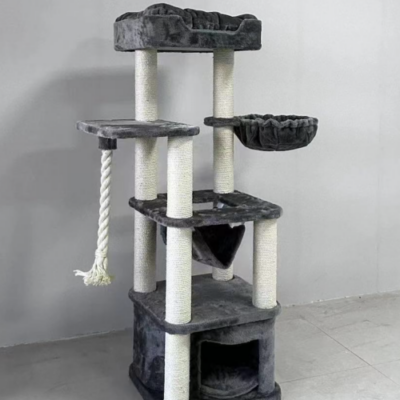
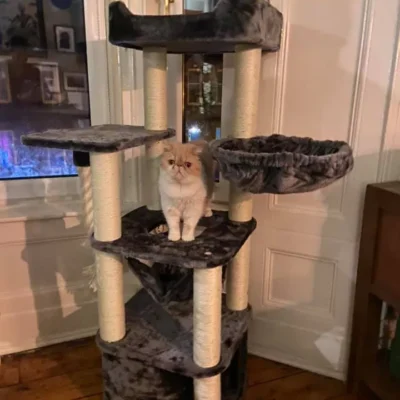
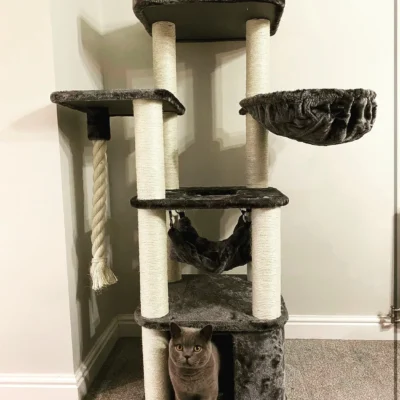
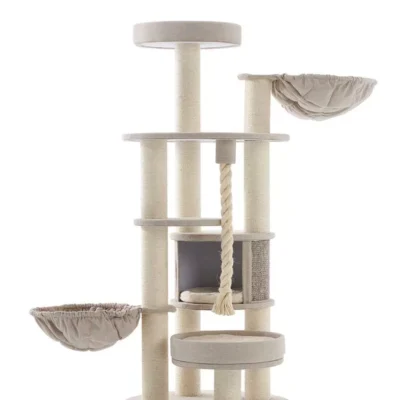
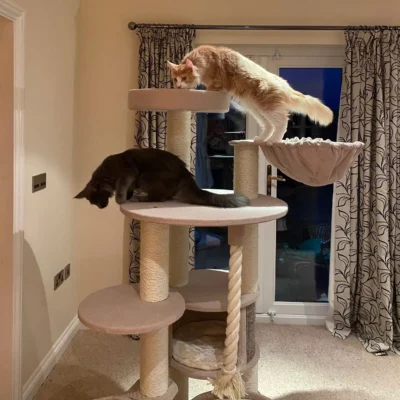
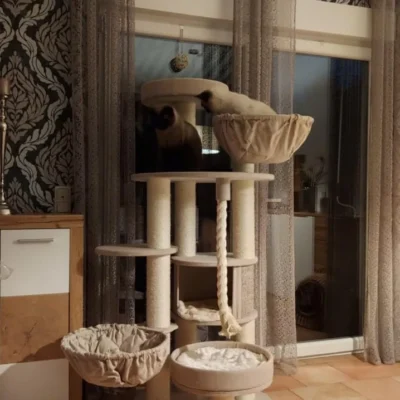
£170 Listed as “Ragdoll Zada Cat Tree” in our shop
The Zada adds a cave, hammock and several places to rest. Its 50 × 50cm base is the smallest in this shortlist, so it is worth considering when you want more levels but have limited floor space.
Check before buying: the manufacturer specifies 9cm posts but does not give every usable bed dimension on the source page. Ask us to confirm the sleeping-space measurements before choosing it for a very large cat.
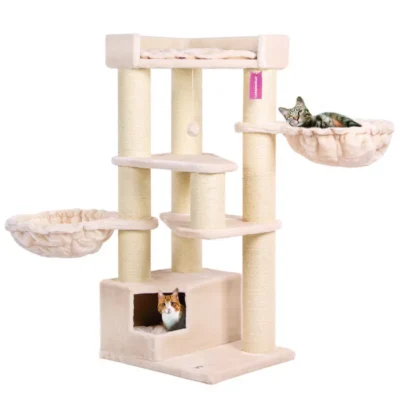
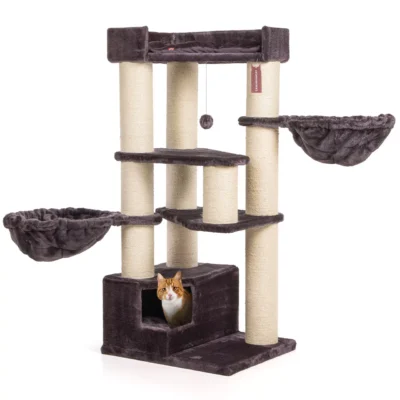
Consider this if your priority is a wider top bed and several resting positions. It has a 65 × 55cm base and 15cm posts. CanadianCat lists the matching C11295 model as Vancouver, with a 60 × 50cm top bed and a 45cm nest.
Check before buying: allow for platforms and beds extending beyond the base. The quoted bed sizes are not a verified load rating; confirm suitability if you have particularly heavy cats or expect them to share a bed.
When buying a cat tree for a Maine Coon, Ragdoll, Savannah, Bengal or any other large cat, prioritise stability and usable dimensions over appearance alone. Check the size of the platforms and beds, the thickness and construction of the support posts, the manufacturer's weight guidance and whether your cat can comfortably climb both up and down. A large cat should be able to stretch, turn around and rest without hanging off every platform.
What Does a Large Cat Need From a Cat Tree?
Large cats have exactly the same basic reasons for using cat furniture as smaller cats: climbing, scratching, resting, observing their surroundings and creating distance from activity at floor level.
The difference is scale.
A platform that comfortably accommodates an average-sized cat may leave a larger cat with half their body hanging over the edge. A lightweight structure that feels perfectly stable under a kitten can move noticeably when a powerful adult cat jumps onto it.
This is why choosing a cat tree for a larger cat should involve more than looking at the total height or a product description that simply says “heavy duty”.
The individual cat matters too.
Breed can provide a useful starting point, but age, body length, weight, confidence, mobility and climbing style are all important. Two cats of the same breed may use a tree completely differently.
Measure the cat, not just the room.
If possible, compare the dimensions of the platforms, beds and hammocks with places your cat already sleeps comfortably. Actual measurements are far more useful than labels such as “XL”, “giant” or “for large cats”.
8 Things to Look for in a Cat Tree for a Large Cat
1
A Wide, Stable Base
The structure should remain steady when your cat launches onto a platform or scratches vigorously.
2
Generous Platforms
Your cat should be able to turn around, sit and lie down without constantly hanging over the edges.
3
Substantial Support Posts
Larger cats place greater leverage on posts and joints, so robust construction matters.
4
Useful Scratching Height
A scratching section should allow your cat to stretch comfortably rather than forcing them into a crouch.
5
Realistic Weight Guidance
Check whether weight limits apply to the whole tree or to individual beds and platforms.
6
Accessible Levels
Large cats need enough room to move between levels without awkwardly squeezing through tiny gaps.
7
Large Sleeping Areas
Hammocks, beds and enclosed houses should be large enough for the cat actually using them.
8
Replaceable Parts
Replaceable scratching posts or cushions can make a substantial tree much more economical over time.
1. Stability Should Be Your First Priority
Tall does not automatically mean good.
A very tall tree with a narrow base can feel considerably less secure than a slightly shorter structure with a wide footprint and well-positioned support posts.
Large cats can generate considerable movement when they jump from the floor onto a higher level. That force does not only travel downwards — it can create sideways movement through the whole structure.
Look for a tree that feels solid when pushed from different directions.
Useful stability features can include:
a wide and appropriately weighted base
multiple support posts between major levels
strong joints and connecting hardware
platforms positioned so the structure remains balanced
anti-tip or wall fixing points where supplied by the manufacturer
Before your cat uses it
Assemble the tree fully, tighten all fittings according to the instructions and give each platform a firm push by hand. Check the fittings again periodically because normal climbing and scratching can loosen connections over time.
2. Check the Actual Platform Dimensions
Product photographs can make platforms look larger than they really are.
This is particularly important when shopping for a large cat because the difference between a 35 cm platform and a 50 cm platform can be significant once your cat tries to lie down.
Before ordering, look for measurements for:
top platforms
intermediate platforms
sleeping beds
hammocks
enclosed houses
openings into enclosed areas
Do not judge suitability purely by the overall height of the tree.
A beautifully tall tree is of limited value if your cat cannot comfortably use its sleeping areas.
CatTree has a dedicated collection of
large cat trees
where you can compare structures intended for bigger cats and multi-cat homes.
3. Sleeping Areas Need to Be Usable
One of the most common issues with standard cat trees is that the beds look substantial in product photographs but are relatively small once a large adult cat climbs into them.
Think about how your cat sleeps.
Cats that curl tightly may happily use a raised round bed, while cats that prefer stretching out may get much more use from a wide flat platform.
Deep hammocks can work extremely well for some large cats provided the hammock itself and its supporting hardware are designed for the load.
If your cat rarely uses enclosed beds elsewhere in the home, do not choose a cat tree primarily because it contains several enclosed boxes.
Buy for your cat's real habits rather than the number of features listed on the product page.
4. Pay Attention to the Scratching Posts
Scratching is an essential feline behaviour, and larger cats need an appropriate surface just as much as smaller cats.
A useful vertical scratching area should allow your cat to reach upwards and stretch comfortably.
Stability also matters here. Cats generally prefer scratching surfaces that remain steady when they pull against them.
When comparing trees, examine:
post diameter
usable scratching height
how much of the post is covered in sisal
whether platforms interrupt the scratching area
whether worn posts can be replaced
Sisal rope and sisal fabric are both commonly used, but construction quality matters just as much as the material itself.
If scratching is your main priority rather than climbing, you may also want to compare dedicated
cat scratching posts
.
5. Understand What the Weight Limit Actually Means
A published weight limit can be useful, but only if you understand what it refers to.
There is an important difference between:
the maximum recommended weight for one platform
the maximum weight for a hammock
the total recommended load across the whole structure
If the specification is unclear, ask the retailer or manufacturer before buying.
Remember that a cat jumping onto a platform also creates movement and force that is different from simply placing an equivalent static weight on it.
For this reason, overall construction quality and stability remain important even when the advertised maximum load comfortably exceeds your cat's body weight.
6. How Tall Should a Cat Tree for a Large Cat Be?
There is no single ideal height.
Many cats enjoy high observation points, and vertical space can give them somewhere to rest and watch the household away from activity at floor level.
However, the tallest tree in the catalogue is not automatically the right one.
Consider:
how confidently your cat currently climbs
the height of the room
the size and stability of the base
how your cat reaches each level
whether there is a safe route back down
your cat's age and mobility
If your large cat particularly enjoys height and you have limited floor space, a properly installed
floor-to-ceiling cat tree
may provide several levels while using a relatively small footprint.
7. Look at How Your Cat Moves Between Levels
This is one of the most overlooked parts of choosing a large cat tree.
A product can have huge platforms but still be awkward for a large cat if the levels overlap badly or the gaps between them are too tight.
Look at the tree as a route rather than a collection of platforms.
Ask:
Where does the cat place their back feet before climbing up?
Is there enough room to turn around?
Can they reach the next level without squeezing around a post?
Can they descend without making an unnecessarily large jump?
Does one sleeping area block access to another?
Large cats need more clearance simply because their bodies occupy more space during each movement.
8. Replacement Parts Can Save You Money
Large, substantial cat trees can represent a significant purchase.
That makes repairability worth considering.
Scratching posts are designed to be scratched, so eventually the sisal will wear. Cushions may also need replacing after repeated washing.
A tree with individually replaceable components may therefore remain useful much longer than one that has to be discarded because a single post has worn out.
Before buying, check whether the manufacturer or retailer offers:
replacement scratching posts
replacement cushions
replacement hammocks
hardware or fittings
Choosing a Cat Tree for Different Large Cat Breeds
Breed can help identify likely size requirements, but avoid assuming that every cat within a breed behaves the same way.
Use breed-specific advice as a starting point and then choose according to the individual cat in front of you.
Maine Coon
Prioritise generous platform dimensions, strong supports and plenty of room to move between levels. Adult Maine Coons can be long-bodied as well as heavy, so usable surface area matters enormously.
Look for roomy beds and broad resting platforms as well as stability. Comfortable lounging space may be just as important as extreme climbing height for an individual Ragdoll.
Athletic cats may appreciate height, climbing routes and several levels, but stability remains essential when a powerful cat moves quickly through the structure.
Active individuals may make frequent use of climbing levels and scratching areas. Pay close attention to the strength of joints and how securely the tree remains planted during energetic movement.
What About Siberians, Norwegian Forest Cats and Other Large Cats?
You do not need a breed-labelled product.
The important question is whether the dimensions and construction suit your individual cat.
A large mixed-breed cat may need every bit as much platform space and stability as a pedigree cat.
Likewise, a smaller individual from a traditionally large breed may not need the biggest tree available.
Treat terms such as “Maine Coon cat tree” as useful shopping categories rather than a guarantee of suitability.
Choosing a Large Cat Tree for Two or More Cats
A multi-cat tree needs more than a high overall weight capacity.
Several cats may want to use different levels at exactly the same time.
Look for:
several genuinely usable resting areas
more than one route through the structure where possible
platforms large enough to pass one another comfortably
multiple scratching surfaces
good stability when weight is distributed unevenly
Do not assume that two cats who live together necessarily want to sleep beside each other.
Providing several elevated resting places gives cats more choice and can help them avoid unwanted interaction.
Cat Tree, Cat Tower or Floor-to-Ceiling Tree?
Type
Advantages
Best Suited To
Freestanding cat tree
Flexible placement, multiple styles and usually combines scratching with sleeping platforms.
Most homes and cats.
Wide large cat tree
Large platforms, generous beds and often excellent stability.
Large breeds and multi-cat households with enough floor space.
Tall tower
Provides height while often using less width than very broad structures.
Confident climbers that enjoy high observation points.
Floor-to-ceiling tree
Makes excellent use of vertical room height and can have a relatively small footprint.
Smaller rooms and cats that particularly enjoy climbing.
Where Should You Put a Large Cat Tree?
Even the perfect tree can be ignored if it is positioned somewhere your cat has no reason to visit.
Useful locations often include:
beside a secure window
in the living room
near an existing favourite sleeping place
in a home office where your cat likes to stay near you
near an existing scratching location
Make sure the flooring is level and that the tree does not obstruct doors or busy walkways.
Tall structures should also be positioned away from hazards your cat could reach by jumping from the upper platforms.
Should a Large Cat Tree Be Attached to the Wall?
Follow the manufacturer's instructions for the specific product.
Some freestanding trees include an anti-tip strap or optional wall anchor, while others are designed to remain stable without additional fixing.
Floor-to-ceiling trees may use tension or dedicated ceiling fittings.
Do not improvise structural changes unless they are appropriate for the product and the surface to which it is being attached.
If an anti-tip fitting is supplied, use it as instructed.
7 Common Mistakes When Buying a Cat Tree for a Large Cat
1
Choosing by Height Alone
A tall tree is not useful if the platforms are tiny or the structure is unstable.
2
Ignoring Platform Measurements
Always check dimensions rather than judging scale from photographs.
3
Trusting “Heavy Duty” Without Specifications
Look for actual construction details, measurements and weight guidance.
4
Buying Tiny Sleeping Caves
A large cat may never use an enclosed space they cannot comfortably turn around inside.
5
Forgetting the Route Down
Cats need a practical way to descend as well as climb upwards.
6
Ignoring Your Cat's Age
An older large cat may prefer closely spaced levels rather than dramatic jumps.
7
Putting It in the Wrong Room
A cat tree hidden somewhere your cat rarely visits may remain unused regardless of quality.
What About Large Older Cats?
A cat does not stop valuing vertical territory simply because they become older.
However, access may need to become easier.
Older cats may benefit from:
smaller gaps between platforms
lower first steps
wide surfaces with good grip
ramps or intermediate steps
sleeping areas that do not require a large jump
If a cat that previously climbed confidently suddenly becomes reluctant to jump or use their tree, discuss the change with your vet rather than simply assuming they have lost interest.
Large Cat Tree Buying Checklist
✓
Stable base: Does the tree remain steady when pushed?
✓
Platform dimensions: Can your cat comfortably sit and lie down?
✓
Sleeping areas: Are beds and hammocks genuinely large enough?
✓
Scratching space: Can your cat stretch properly while scratching?
✓
Weight guidance: Is it clear what each limit refers to?
✓
Climbing route: Can your cat move naturally between levels?
✓
Descent: Is getting down as practical as getting up?
✓
Replacement parts: Can worn components be replaced?
✓
Room dimensions: Have you checked the full assembled footprint?
Frequently Asked Questions
What is the best cat tree for a large cat?
The best choice is a stable tree with platforms, beds and climbing routes large enough for your individual cat. Look at actual measurements, construction and weight guidance rather than relying only on terms such as “large” or “heavy duty”.
Do Maine Coons need special cat trees?
Maine Coons often benefit from larger platforms, strong supports and generous sleeping areas because of their size and body length. A product does not have to carry a Maine Coon label, however, provided its dimensions and construction are suitable.
How tall should a cat tree for a large cat be?
There is no universal ideal height. Choose according to your cat's climbing ability, age, room size and preference for elevated resting places. Stability and usable platform size are at least as important as overall height.
Are floor-to-ceiling cat trees suitable for large cats?
They can be, provided the specific product is designed for the cat using it and is installed correctly. Check platform dimensions, weight guidance and the manufacturer's fitting instructions.
How do I know whether a cat tree is stable enough?
Look for a broad base, substantial posts and strong connections between levels. Once assembled, the structure should remain steady when pushed from several directions. Use any supplied anti-tip fittings according to the instructions.
What size platform does a large cat need?
There is no single measurement that fits every cat. Compare the platform dimensions with surfaces your cat already sleeps on comfortably and make sure they can turn around and lie down without being excessively cramped.
Can two large cats share one cat tree?
Yes, if the structure is designed to support them and provides enough separate resting areas. In multi-cat homes, several platforms and routes are preferable so the cats do not have to compete for one prized perch.
Is a heavier cat tree always safer?
Not necessarily. Overall stability depends on the design, base dimensions, centre of gravity, joints and construction as well as total weight.
Should I buy the biggest cat tree available?
No. Choose the tree that best fits your cat's size, mobility and habits as well as the space available in your home. A moderately sized but stable and well-designed tree can be more useful than an enormous structure with awkward platforms.
The Bottom Line
Buying a cat tree for a large cat is mostly about choosing usable space and solid construction rather than chasing the tallest product or the longest feature list.
Start with stability. Then check the actual platform, bed and hammock dimensions, scratching height, weight guidance and route between levels.
Most importantly, choose for the individual cat. A young athletic Bengal may use a tree very differently from an older Ragdoll, while two Maine Coons can have completely different sleeping and climbing preferences.
A well-chosen large cat tree should give your cat somewhere comfortable to climb, scratch, observe and rest without feeling as though they have been squeezed onto furniture designed for a much smaller animal.
Shop Cat Trees for Larger Cats
Browse our complete collection of
large cat trees
for bigger cats and multi-cat households.