0

08 Jun Cat Trees for Norwegian Forest Cats: A Buying Guide
Choose a Norwegian Forest cat tree with a stable climbing route, roomy landing areas and beds that fit. Check the descent, not just the height of the top perch.
If your Norwegian Forest Cat enjoys exploring high furniture, a well-planned cat tree can give that climbing habit a useful home. Height alone is not the answer: the route needs to work for a substantial cat moving both up and down.
This guide focuses on the details that are easy to miss in a product photograph, from landing space and overhanging platforms to cleaning around long fur and allowing room for growth.
Match the tree to the cat in front of you
Norwegian Forest Cats are large, muscular cats with a semi-long coat. The GCCF notes that they mature slowly. Those characteristics make size and future fit relevant, but they do not mean every individual wants the same height or type of furniture.
Watch your cat's preferred routes at home. Do they move from chair to shelf in stages, leap onto a broad surface or stay close to the floor? Notice where they pause and how they come down. That gives you a more useful shopping brief than assuming that a climbing reputation makes every tall structure suitable.
For a young cat, allow for adult resting space while keeping the present route manageable. For an older cat, prioritise current comfort. A tree is an everyday resource, not a challenge your cat should have to complete to reach its only bed.
Plan a continuous route
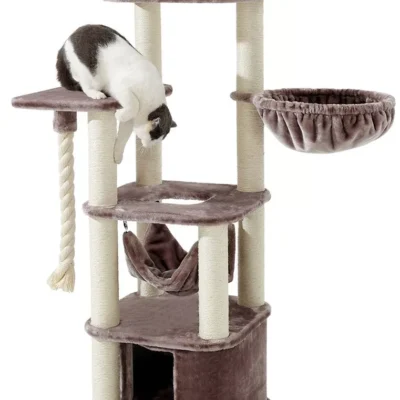
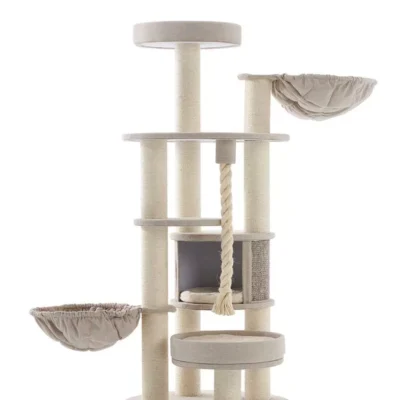
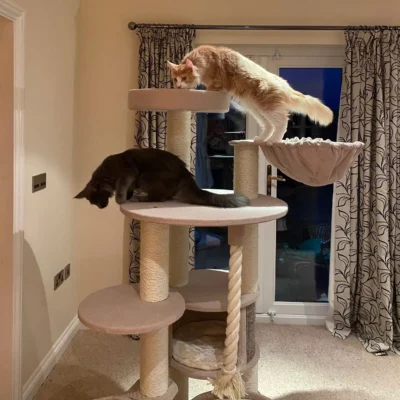
Study the platform arrangement from more than one angle. On some trees, the upper levels line up so closely that a cat has little room to step through. On others, wide gaps require substantial jumps. Neither the number of levels nor the total height tells you the whole story.
Trace a path from the floor to the resting areas and back. Look for places to pause, turn and put all four paws on a secure surface. A narrow intermediate shelf may be a useful step for a small cat but awkward for a large adult changing direction.
Do not rely on breed stories about climbing down trees headfirst as a reason to overlook the descent. An indoor tower has different surfaces, spacing and edges. Your cat still needs a practical route down that suits its actual confidence and mobility.
Compare height with usable space
| Feature | Useful question | Why it matters |
|---|---|---|
| Total height | Will my cat use the upper level? | Unused height does not compensate for cramped beds |
| First platform | Can my cat reach it comfortably? | The whole route depends on its starting point |
| Intermediate stages | Is there room to pause and turn? | They need to function as usable landing areas |
| Top bed | What is the space inside the rim? | Outside diameter may exaggerate resting room |
| Projecting basket | What supports it and what limit applies? | The tree's overall rating may not describe the basket |
Assess the base and connections
An active cat uses a tree dynamically, so look beyond whether it appears to hold weight in a still photograph. Compare the footprint, post positions, platform supports and any manufacturer-specified restraint. Ask about unclear component limits before ordering.
Substantial posts can be useful, but diameter alone cannot tell you whether a joint is sound. Ask how the posts attach and whether replacement parts are model-specific. A covered board and a timber platform can both work well when supported appropriately; the materials guide explains the differences to investigate.
Assemble on a level surface and use the specified hardware. Check for rocking, loose inserts and damaged components before your cat explores. If a wall restraint is required, position the tree where it can be installed correctly. A convenient corner is not a replacement for that restraint.
Allow generous sleeping and scratching room
Compare beds with a sleeping place your cat already uses. Measure its usable area rather than its full outside dimensions. A longhaired cat can look larger because of its coat, but it still needs genuine body room beneath that fur; do not guess either way from a photograph.
For a den, check the entrance, internal height and floor area. The cat should be able to enter and turn without having to negotiate a post immediately outside the opening. For a hammock, check support, depth and the exit to a firm platform.
Look separately at scratching space. A tower with many short posts can offer less uninterrupted stretch than one dedicated tall post. If your cat prefers a horizontal scratcher, retain that option rather than expecting the new tower to meet every scratching preference.
Position it as part of the room
Choose a familiar area with enough clearance for approach and descent. A tree squeezed between a sofa arm and a door may leave its most useful platform difficult to reach. Remember that projecting beds can extend beyond the base footprint.
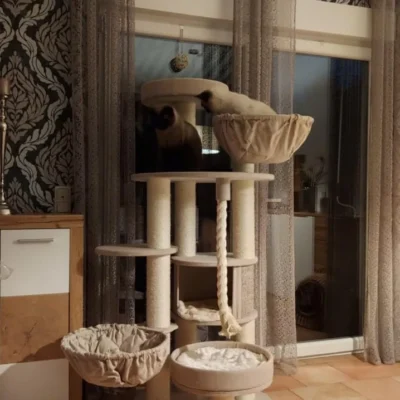
A view through a secure window can make a perch attractive, but assess the view itself. If another cat outside repeatedly upsets yours, that position may be less restful than expected. Keep access to blind cords, open windows, heaters and fragile objects out of the route.
Do not create a new path onto an unstable bookcase or a narrow high ledge. Think about where your cat might go next from the top platform, rather than treating the tree as isolated from the rest of the room. If the surrounding route is unsuitable, choose another position.
Offer choice in a multi-cat home
A large tree can provide several resting areas, but all those places may still share one entrance route. Watch whether one cat sits at the first platform and prevents another from climbing. Separate resting and scratching options elsewhere remain useful even when the main tree is spacious.
If cats tend to share a bed, check the guidance for that individual bed. Do not treat the overall tree rating as permission to load every cat onto one hammock. Keep another comfortable option available rather than trying to teach cats to occupy particular levels.
When choosing between two designs, compare access routes as well as bed count. Two broad usable places can be more valuable than several cramped cubbies, especially if the cats need to pass one another.
Keep longhaired-cat maintenance practical
Check that you can reach fabric seams, the underside of hammocks and corners of enclosed beds. Removable covers can help, but confirm the washing instructions and how each part reattaches. Avoid draping loose bedding over a landing stage where it could slide.
Vacuum and inspect during routine cleaning. Look for snagged fabric, long loose threads, unravelled rope and worn edges. Pay particular attention to favourite launch and landing points, which may receive more wear than an unused upper bed.
Keep the model details and assembly instructions so replacements can be matched correctly. A new post must be compatible with the original connections, not merely similar in colour or diameter. If structural damage appears, stop using the affected area until the supplier has advised on repair or replacement.
Introduce it and review actual use
Let your cat explore voluntarily. Start any play near accessible lower stages and avoid luring a cat into a leap that the layout does not comfortably support. Keep existing resting places available while you learn which parts of the new tree appeal.
After a few days, note the route used, the favourite bed and any hesitation. A cat that consistently avoids one stage may be telling you about access, movement or space. If reluctance is new or accompanied by stiffness, seek veterinary advice rather than assuming boredom.
Browse large cat trees with those observations in mind. The product selection below is a starting point; check each listing's current measurements and requirements before deciding it suits your Norwegian Forest Cat.
Frequently asked questions
Is the tallest tree always best for this breed?
No. Useful platforms, a stable frame and a manageable route matter more than a height record. Choose taller furniture when your individual cat will use it comfortably.Can I add wall shelves later?
Only with a suitable wall, appropriate fixings and a carefully planned route. A freestanding tree does not automatically make a safe starting point for any shelf arrangement. Each component needs to suit the cat and installation.Does the breed's coat make an indoor tree suitable outdoors?
No. The cat's coat tells you nothing about the furniture's resistance to weather. Indoor boards, fabrics and adhesives should remain indoors unless the product is explicitly designed for outside use.Sources and further reading
-
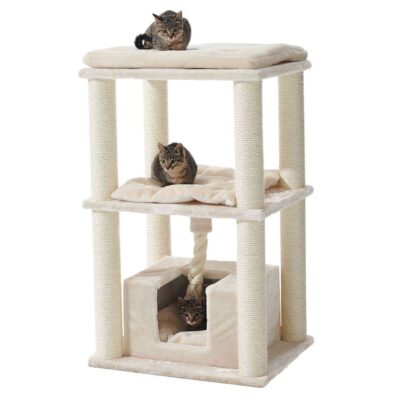
Ragdoll Zada Cat Tree
Original price was: £253.40.£170.00Current price is: £170.00. -
Canadian Corner Coon Activity Centre (Cream)
Original price was: £403.89.£269.54Current price is: £269.54. -
Ragdoll Zada Cat Tree (Anthracite)
Original price was: £212.25.£184.30Current price is: £184.30. -
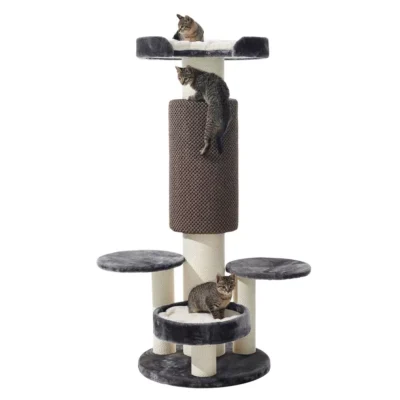
Canadian Corner Coon Activity Centre (Anthracite)
Original price was: £403.89.£269.00Current price is: £269.00. -
Wall-Mounted Cat Tree Dolomit XL Tofana
Original price was: £238.61.£225.00Current price is: £225.00. -
Cat Tree “Brida”
Original price was: £289.82.£244.99Current price is: £244.99. -
Cat Tree Arto
Original price was: £463.67.£370.19Current price is: £370.19. -
BARELI Cat Tree
Original price was: £329.71.£277.64Current price is: £277.64. -
Ragdoll Zada Cat Tree (Cappuccino)
Original price was: £212.25.£182.57Current price is: £182.57. -
Maine Coon Fiida Cat Tree
Original price was: £432.18.£392.28Current price is: £392.28. -
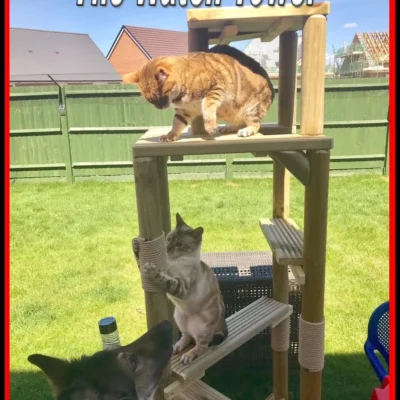
The Watch Tower
£232.00 -
Cat Tree Estaca
£251.36