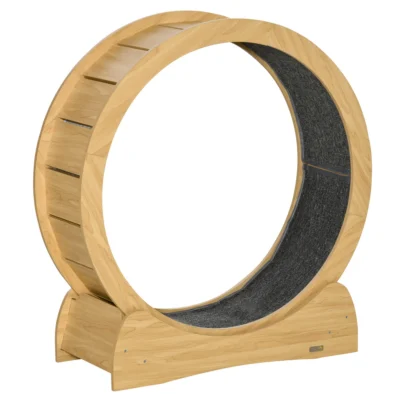
0
Extra Voluntary Activity
A wheel can provide another way for an interested cat to move around indoors.
A cat exercise wheel can provide an extra opportunity for voluntary activity, particularly for energetic indoor cats — but it is not something every cat needs or will enjoy.
Some cats learn to use running wheels regularly, while others remain completely uninterested. The key is choosing an appropriately sized, stable wheel and allowing your cat to decide whether they want to use it.
The quick answer
Cat exercise wheels can be useful enrichment for some cats and there is limited research suggesting they may increase voluntary activity in certain cats. However, they are not proven weight-loss machines, they do not replace normal play and climbing, and cats should never be forced to run on one.
They can — but the answer depends heavily on the individual cat.
A running wheel gives a cat the opportunity to walk or run indoors without needing a long stretch of open floor space. Some cats learn to use the wheel voluntarily and may return to it regularly.
Others may investigate it once and never show much interest again.
That variation is important. A cat wheel should be viewed as optional enrichment, not essential equipment and not something your cat must be trained to use at all costs.
Your cat does not need to become a feline marathon runner. Cats naturally tend to be active in short bursts, including chasing, climbing, pouncing and play.
A wheel can provide another way for an interested cat to move around indoors.
Particularly active cats may enjoy having another outlet alongside play and climbing.
A running wheel adds variety to an indoor environment when combined with other forms of enrichment.
Once comfortable with the wheel, some cats may choose to use it without human involvement.
A wheel provides a different type of activity from scratching, climbing or chasing toys.
Additional activity may form part of a wider veterinary weight-management plan, although the wheel itself is not a treatment for obesity.
There is some published research, but considerably less than many marketing claims suggest.
One 2017 study investigated whether access to a running wheel increased voluntary activity in domestic cats.
The study included 19 cats: eight older neutered males and eleven younger intact females. After a period of wheel habituation, the younger female cats showed increased voluntary activity during the dark period, while the male cats did not show the same increase.
The study did not show that cat wheels guarantee increased exercise, weight loss or improved behaviour in every cat.
The researchers themselves noted that age, sex and neuter status differed between the groups and that more research was needed.
So the fairest conclusion is that wheels may help increase voluntary activity for some cats, rather than claiming they universally improve feline fitness.
Exercise wheels may be particularly appealing to:
Breed does not guarantee enthusiasm. A Bengal or Maine Coon may completely ignore a wheel while an ordinary domestic shorthair becomes obsessed with it.
Personality matters more than marketing labels.
A wheel may not be appropriate for every cat.
Speak to your vet before introducing demanding new exercise if your cat:
Very young kittens also need age-appropriate activity rather than being encouraged to perform prolonged running.
Size is one of the most important things to check.
Your cat should be able to walk or run naturally without appearing excessively hunched or having to curve their spine sharply.
If you are ready to compare models, browse our cat exercise wheels .
A wheel should be designed so your cat can enter, run and leave without obvious trapping or stability hazards.
Inspect the wheel periodically for loose fittings, worn running surfaces or damaged components.
Never force a frightened cat onto a moving wheel. Your cat should always be able to step off immediately if they want to.
Introduce the wheel slowly and keep the process positive.
Avoid physically holding your cat on the wheel or blocking their exit.
If they remain uninterested after a patient introduction, they may simply prefer other forms of activity.
Additional activity can be useful, but weight loss in cats is primarily a nutrition and veterinary-management issue rather than an exercise-equipment problem.
An overweight cat should not simply be placed onto a wheel and encouraged to run intensely.
If your cat needs to lose weight, speak to your vet about:
A wheel may then be one optional way of increasing voluntary activity if your cat enjoys using it.
They can be useful, but an indoor cat needs far more than a wheel.
A varied indoor environment should also provide opportunities to:
PDSA and Cats Protection both emphasise regular play and varied enrichment for indoor cats rather than relying on one activity.
You can combine a wheel with cat activity centres , cat trees and scratching posts .
That is completely fine.
There are plenty of other ways to encourage activity.
Wand toys and chase games encourage short bursts of natural hunting-style movement.
Climbing furniture adds vertical movement and elevated resting areas.
Food puzzles combine movement with mental problem-solving.
Scratching allows stretching and muscular activity while supporting normal feline behaviour.
| Potential Advantages | Potential Drawbacks |
|---|---|
| Can provide extra voluntary activity | Some cats never use them |
| Can suit energetic indoor cats | Large wheels require significant floor space |
| Allows independent use once learned | Good-quality wheels can be expensive |
| Adds variety to indoor enrichment | Incorrect sizing can make running uncomfortable |
| May support wider activity goals | Does not replace play, climbing or weight-management advice |
Compare the sizes, running diameters and designs in our current cat-wheel collection before choosing the model that best suits your cat and available space.
Browse Cat Exercise WheelsThey can provide extra voluntary activity for some cats, particularly active indoor cats. They are best treated as optional enrichment rather than something every cat needs.
Some do. Published research has shown voluntary wheel use and increased activity in some cats after habituation, but individual responses vary considerably.
A wheel may add voluntary activity, but feline weight loss should be managed primarily through appropriate nutrition and veterinary guidance. It should not be treated as a standalone weight-loss solution.
Choose a wheel large enough for your cat to walk or run without appearing excessively hunched. Check the internal diameter, track width and manufacturer guidance for the specific model.
They can be suitable if the wheel is large enough for the individual cat. Long-bodied and larger cats generally require a more generous running diameter.
There is no universal target. Let your cat use the wheel voluntarily rather than requiring a particular duration. Cats naturally tend to exercise in shorter bursts.
Some mobile senior cats may be comfortable using one, but older cats are more likely to have arthritis or other health problems. Ask your vet if you are unsure whether demanding exercise is appropriate.
Do not force them. Use other forms of activity such as interactive play, climbing furniture, puzzle feeders and scratching areas instead.
Cat exercise wheels can be useful enrichment for some cats, but they are not a universal solution for feline fitness.
Research suggests that wheel access may increase voluntary activity in some cats, but the evidence is limited and individual responses vary considerably.
Choose a suitably sized, stable wheel, introduce it gradually and let your cat decide whether they enjoy using it.
Most importantly, keep the wheel as one part of a broader enrichment routine that includes play, climbing, scratching and opportunities to rest and explore.
Research source: 2017 study of activity before and after running-wheel habituation.