Is My Cat Bored? Signs to Check and Enrichment Ideas
Cats may spend a large part of the day sleeping, but that does not mean they need nothing to do when they are awake. Indoor cats in particular need opportunities to climb, scratch, stalk, chase, explore and solve simple problems.
When those opportunities are limited, some cats can become frustrated or under-stimulated. The difficulty is that there is no single behaviour that proves a cat is bored. Restlessness, increased vocalising, overgrooming or destructive behaviour can have many different causes.
The best approach is to look at your cat's behaviour as a whole, rule out health problems when something has changed, and then make their environment more interesting in ways that suit the individual cat.
Quick answer
A bored cat may become unusually restless, demand more attention, redirect play onto people or furniture, or seem frustrated by a lack of activity. However, these behaviours are not specific to boredom. Sudden or significant behavioural changes should be discussed with your vet before assuming your cat simply needs more entertainment.
Can Cats Get Bored?
Yes. Cats need opportunities to express normal feline behaviours rather than spending every waking hour moving between the food bowl and the sofa.
Hunting-related behaviours are particularly important. Even a well-fed cat can still have a strong motivation to stalk, chase, pounce and catch things because hunting behaviour is not driven by hunger alone.
Indoor cats may need more deliberate enrichment because many of the sights, scents, movement and hunting opportunities available outdoors are absent from the home.
Boredom and rest are not the same thing
Cats naturally spend a great deal of time resting and sleeping. A cat having a long afternoon nap is not automatically bored. Look for changes from your cat's normal behaviour rather than judging them by how many hours they spend asleep.
10 Possible Signs Your Cat Is Bored
None of the following signs proves boredom by itself. Many can also occur because of pain, stress, illness, anxiety or other behavioural problems.
01Persistent Attention Seeking
Your cat repeatedly follows you, interrupts activities or demands interaction more than usual.
02Restlessness or Pacing
They seem unable to settle despite having already eaten, rested and used their litter tray.
03More Vocalising
Some cats become noticeably more vocal when seeking interaction or stimulation.
04Rough Play With People
Hands, ankles or feet may become substitute prey when better play opportunities are limited.
05Destructive Behaviour
Your cat may investigate, knock over or chew household objects in search of activity.
06Increased Scratching
A lack of suitable scratching areas can result in furniture becoming the most interesting option.
07Overgrooming
Excessive grooming can occur with stress or frustration, but medical causes must also be considered.
08Overeating
Some cats may repeatedly visit the food area when little else is happening.
09Frequent Bursts of Activity
Repeated frantic running may sometimes reflect pent-up energy, although normal zoomies are common too.
10Reduced Interest in Normal Activities
A cat that seems unusually withdrawn or disengaged may need veterinary assessment rather than simply more toys.
Behaviour change? Rule out medical causes first.
If your cat suddenly becomes withdrawn, aggressive, excessively vocal, stops playing, begins overgrooming or changes their eating or toileting habits, contact your vet. Do not assume the problem is boredom.
WAY 01
1. Use Interactive Play to Mimic Hunting
Interactive play is one of the most effective forms of feline enrichment because it allows your cat to stalk, chase and pounce on something that behaves like prey.
Wand and fishing-rod-style toys work particularly well because the toy can move away from your body rather than teaching your cat that hands and feet are appropriate targets.
Move It Like Prey
Try short movements, pauses, hiding and sudden escapes rather than waving the toy constantly in your cat's face.
Let Them Catch It
Give your cat opportunities to successfully pounce on and capture the toy instead of making every chase impossible.
Keep Sessions Short
A few enthusiastic minutes may be more useful than a long session after your cat has lost interest.
Put String Toys Away
Do not leave toys with strings, cords or easily swallowed pieces available when nobody is supervising.
Cats Protection notes that even one- or two-minute play sessions can be worthwhile and recommends several short sessions through the day where possible.
WAY 02
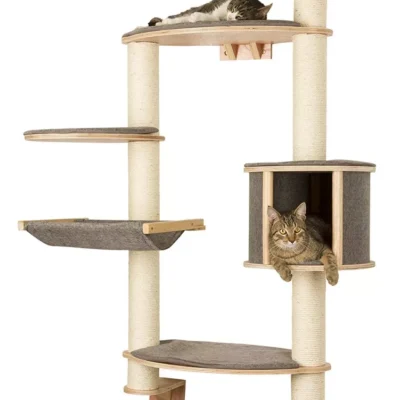
2. Give Your Cat Vertical Space
A home becomes much more interesting to a cat when usable territory extends above floor level.
Elevated positions allow cats to climb, observe the room, rest away from household activity and choose different routes through their environment.
Options can include shelving, window platforms or a stable
cat tree.
The best setup depends on your cat. Young athletic cats may enjoy taller structures, while older cats may benefit from lower steps and smaller gaps between platforms.
WAY 03
3. Provide Places to Scratch
Scratching is not bad behaviour. It is a normal part of being a cat.
Cats scratch for several reasons, including stretching, maintaining their claws and leaving visual and scent signals.
Provide scratching options in places where your cat actually spends time rather than hiding one post in an unused corner.
Some cats prefer tall vertical surfaces, others enjoy horizontal cardboard scratchers, and many use both. You can browse our
cat scratching posts
or read our guide explaining
why cats scratch furniture
.
WAY 04
4. Make Mealtimes More Interesting
A bowl is convenient, but it gives a cat almost nothing to do before eating.
Puzzle feeders and food-searching games can turn part of the daily food allowance into an activity.
Start easy
A puzzle that is too difficult may simply frustrate a beginner. Let your cat see, smell and obtain the food easily at first, then gradually make the activity more challenging.
Use part of your cat's normal daily food rather than continually adding extra treats, particularly if weight control is important.
WAY 05
5. Rotate Toys Instead of Leaving Everything Out
Buying twenty toys and leaving all twenty on the floor permanently does not necessarily create twenty times the entertainment.
Familiar objects can lose some of their novelty. Try keeping a selection of toys stored away and rotating them every few days.
You may discover that an old toy suddenly becomes fascinating again after disappearing for a week.
Inspect toys regularly
Throw away damaged toys that have exposed filling, broken pieces, loose string or components that could be swallowed.
WAY 06
6. Give Your Cat Something Interesting to Watch
A secure window can provide a changing view of birds, people, leaves and outdoor activity.
If your cat enjoys watching outside, position a stable perch, bed or cat-tree platform near a suitable window.
Make sure windows are safely secured. An open or tilted window can present a serious hazard, so visual enrichment should never come at the expense of physical safety.
Remember that not every cat finds every view relaxing. If an unfamiliar neighbourhood cat repeatedly appears outside and your cat becomes agitated, staring out of that particular window may actually increase stress.
WAY 07
7. Teach Your Cat Something Simple
Cats are perfectly capable of learning through reward-based training.
Short training sessions can add variety to the day while giving your cat an opportunity to solve a problem.
Respond to Their Name
Touch a Target
Step Onto a Mat
Enter Their Carrier
Keep the difficulty low at first, reward successful attempts and stop while your cat is still interested.
WAY 08
8. Create New Things to Explore
Enrichment does not have to be expensive.
Cardboard boxes, paper packing material, tunnels and safely positioned hiding places can transform an otherwise familiar room.
Try occasionally changing the arrangement rather than permanently rearranging your cat's whole territory.
Boxes
Cut suitable entrance holes and let your cat hide, explore or ambush toys from inside.
Tunnels
Useful for hiding, running through and interactive games.
Hidden Toys
Place a familiar toy somewhere slightly different and let your cat discover it.
Food Searches
Hide a small portion of dry food in easy-to-find locations around a safe room.
WAY 09
9. Consider Safe Outdoor Enrichment
Outdoor sights, sounds and smells can provide enormous stimulation, but unrestricted outdoor access is not appropriate for every cat or every location.
Where practical, a securely enclosed catio or other safe outdoor enclosure can give an indoor cat access to fresh air and environmental variety while limiting some outdoor risks.
10. Build Enrichment Into Your Cat's Daily Routine
Enrichment works better as part of normal life than as something you suddenly provide once every few weeks.
You do not need to entertain your cat continuously. Cats also need plenty of uninterrupted rest and opportunities to do things independently.
MORNINGShort play session or food puzzle
DAYTIMEWindow view, climbing areas and independent toys
EVENINGInteractive stalking and chasing game
QUIET TIMEUndisturbed sleep and hiding spaces
Adjust the routine to the individual. A young high-energy cat may want considerably more activity than an elderly cat.
Should You Get Another Cat Because Your Cat Is Bored?
Not automatically.
It sounds logical that two cats will entertain each other, but cats do not universally want another cat living in their territory.
Some form strong social bonds. Others simply tolerate one another, and some become stressed when forced to share space and resources.
A second cat is a major commitment, not an enrichment toy
Do not adopt another cat solely because the first one appears bored. Consider your existing cat's temperament, history and response to other cats, and introduce any new cat gradually.
Enrichment in a Multi-Cat Home
If you already have several cats, more enrichment should not mean making every cat compete for the same desirable object.
Provide important resources in different locations so cats can use them without having to pass or confront another cat.
Multiple Resting Areas
Several Scratching Places
Separate Feeding Locations
Multiple High Places
Hiding Areas
Separate Litter-Tray Locations
Cats Protection recommends providing essential resources for each cat plus a spare in multi-cat homes and distributing them around the home rather than creating one shared station.
When Is It More Than Boredom?
One of the biggest mistakes is assuming that every behaviour problem can be fixed with another toy.
Contact your vet if you notice a significant or sudden change such as:
!
sudden aggression or irritability
!
major changes in appetite or drinking
!
new litter-tray problems
!
excessive or damaging grooming
!
persistent hiding or withdrawal
!
reduced mobility or reluctance to jump
!
loss of interest in activities they previously enjoyed
!
any other behaviour that appears markedly unusual for your cat
Once medical problems have been ruled out, your vet may recommend working with an appropriately qualified feline behaviour professional if the problem continues.
A Simple Daily Enrichment Plan
You do not need to convert your home into an amusement park. Start with a few basics:
✓
Several short interactive play opportunities
✓
At least one suitable scratching area
✓
Access to comfortable elevated space
✓
Places to hide and sleep undisturbed
✓
Some food delivered through enrichment
✓
A small selection of rotated toys
✓
Safe opportunities to watch or explore
✓
Plenty of quiet time as well as activity
Cat Boredom FAQs
How can I tell if my cat is bored?
Possible signs include restlessness, increased attention seeking, excessive vocalising, destructive behaviour or redirected play towards people. None of these behaviours is specific to boredom, so significant or sudden changes should be discussed with your vet.
Do indoor cats get bored more easily?
Indoor cats rely more heavily on the home environment and their owner to provide opportunities to climb, scratch, explore, hunt through play and solve simple problems. A well-designed indoor environment can still be highly stimulating.
How many times a day should I play with my cat?
Several short sessions can work well. Cats Protection notes that even very short one- or two-minute games can be useful. The ideal amount depends on your cat's age, health and individual enthusiasm for play.
Why does my cat seem bored but refuse to play?
Try different styles of toy, vary the movement and experiment at different times of day. If your cat has suddenly lost interest in play or also seems lethargic, uncomfortable or unwell, arrange a veterinary check.
Can a cat tree help with boredom?
A cat tree can provide climbing, scratching, resting and observation opportunities, making it a useful form of environmental enrichment. It works best as part of a broader environment that also includes play, hiding places and other activities.
Are puzzle feeders good for cats?
They can provide useful mental and physical enrichment. Start with an easy puzzle and use part of the cat's normal food allowance rather than continually adding extra calories.
Should I get another cat to stop my cat being bored?
Not solely for that reason. Some cats enjoy feline companionship while others find another cat stressful. A second cat is a long-term addition to the household and should not be treated simply as entertainment for the first.
Is sleeping all day a sign that my cat is bored?
Not necessarily. Cats naturally sleep and rest for long periods. A noticeable increase in sleeping combined with reduced interest in food, play or normal activity is more significant and may justify a veterinary check.
Can I leave toys out while I am at work?
Only leave toys that are safe for unsupervised use. Toys with string, elastic, feathers or small detachable pieces may be better stored away until you are present.
Further Cat Enrichment Advice
For additional guidance, see
Cats Protection's advice on play
and
their guide to caring for indoor cats
.
The Bottom Line
A cat does not need constant entertainment, but they do need opportunities to behave like a cat.
Interactive play, climbing areas, scratching surfaces, hiding places, food puzzles and opportunities to explore can make even a completely indoor environment much more interesting.
Start with your individual cat rather than trying to use every enrichment idea at once. Some cats love chasing toys, some prefer climbing and watching, and others become surprisingly enthusiastic about earning dinner from a cardboard puzzle.
Most importantly, do not use boredom as an automatic explanation for a significant behaviour change. If your cat suddenly behaves differently, rule out pain or illness first and then look at how their environment could better meet their needs.