0
15 Nov Cat Trees with Hammocks: A UK Buying Guide
The three answers to get before choosing a hammock
Ask for these details together, especially if the hammock is the main reason you are considering the tree:
- Usable sleeping space: the internal width and depth, not just the outer ring or padded rim.
- Component guidance: any weight limit for that particular hammock, including whether it is intended for one cat.
- Replacement and care: whether the cover or complete hammock can be removed, how it is cleaned and which replacement fits.
How to read an incomplete listing
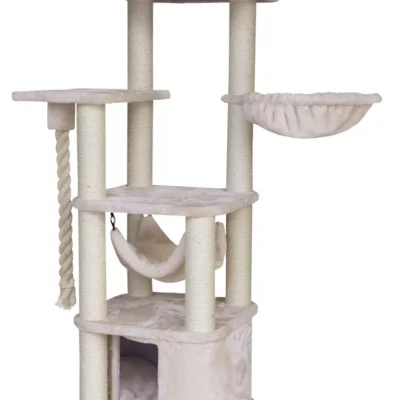
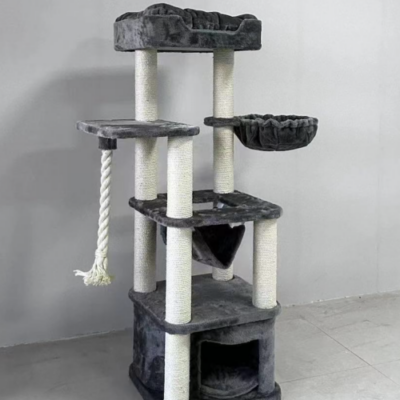
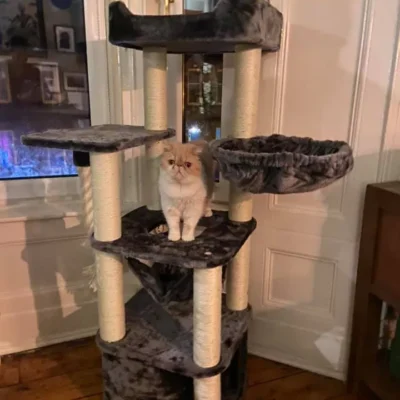
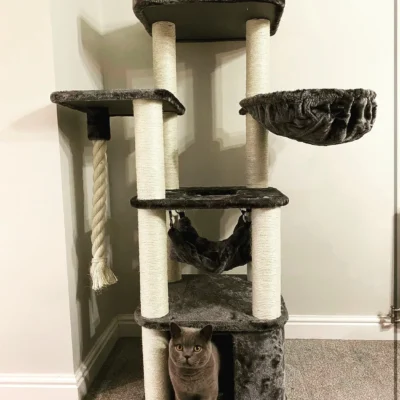
Nobby’s Zada listing confirms a hammock among its resting areas, but the manufacturer page we checked does not supply every usable bed measurement or a hammock load rating. That is a reason to ask for clarification—not to infer a capacity from the product name or the tree’s overall size.
See Nobby’s Zada specification · View the product.
Do not add several individual bed limits together and assume the result is a verified total capacity for the tree. Those are different specifications.
Product examples checked 19 October 2026. Confirm current specifications before ordering.
Compare hammock size, support, depth and individual weight guidance. A soft bed should also have a secure attachment, a practical exit and a cover you can maintain.
A hammock can be the most-used part of a cat tree—or the attractive feature your cat never chooses. The difference often comes down to shape, size, movement and access rather than how cosy it looks in a photograph.
This guide helps you distinguish hanging slings from supported baskets, measure the usable sleeping space and choose a design that works as part of the whole tree.
Understand what the listing calls a hammock
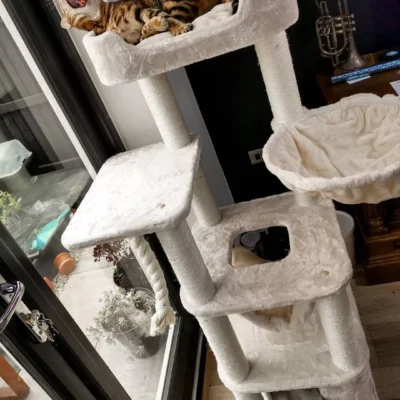
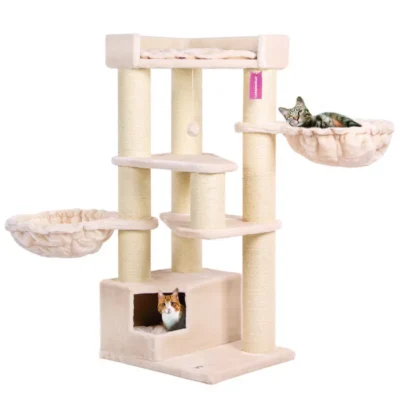
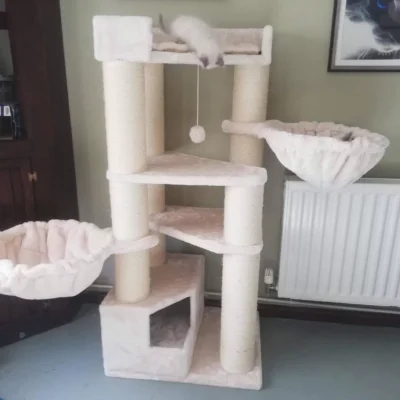
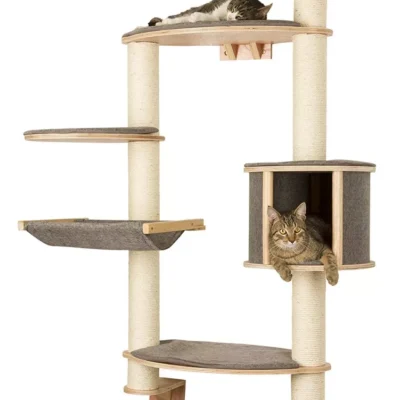
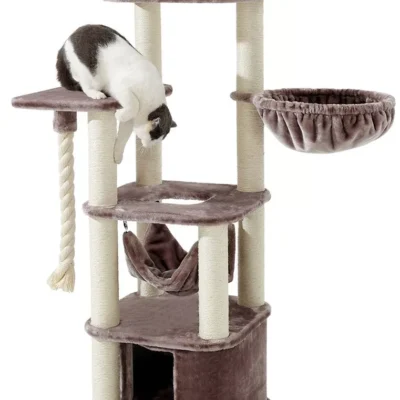
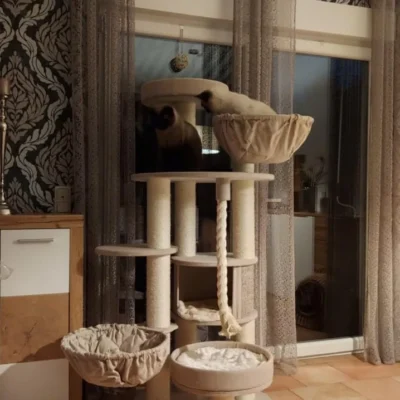
The word “hammock” is used for several designs. Some are fabric slings suspended between supports. Others are soft baskets on a rigid ring, attached beside a post. A padded fixed bed may look similar in photographs but behave differently when the cat steps onto it.
Look closely at the support underneath and the attachment points. Ask for a clearer image if the bedding hides them. The relevant question is how the sleeping surface behaves in use, not which name sounds most comfortable.
If your cat prefers firm furniture, keep a firm bed available. If it curls happily into soft bedding, a supported basket may be worth comparing. Neither preference proves that a specific hammock will be accepted, so choose it as one resting option rather than the only usable bed.
Compare the main hammock styles
| Style | How it works | What to inspect |
|---|---|---|
| Fabric sling between supports | The fabric forms a suspended resting surface | Attachment points, depth and how the cat enters and leaves |
| Ring-supported basket | A soft bed hangs within a rigid frame | Frame connection, usable diameter and cover condition |
| Broad fabric bed beneath a platform | A lower sleeping area hangs within the structure | Headroom, access and clearance when occupied |
| Fixed padded bed | A firm base carries a cushion or soft covering | Internal dimensions and whether the cushion stays in place |
Measure the actual sleeping area
For a circular hammock, ask whether the stated diameter measures the outside frame or the usable space inside it. For a sling, request the supported length and width and consider how those dimensions change as the fabric curves.
Compare with a bed your cat already uses. A tightly curled posture is not the only position to allow for; the cat should be able to shift and settle comfortably. Large breeds may need more usable room than a photograph suggests, particularly where a thick rim takes up space.
Depth matters too. Check how far the hammock hangs below its attachment and what sits underneath. It should not rest against a lower platform or create an awkward gap when used as intended. If the listing does not make the shape clear, ask before ordering.
Read the individual weight guidance
The capacity quoted for an entire tree may not describe a projecting hammock. Ask what guidance applies to that particular bed and whether it is intended for one cat. “For large cats” is less useful than a clear model-specific answer.
If your cats tend to sleep together, consider the possibility that both will try the same hammock. Do not assume separate beds guarantee separate use. Choose a design suited to the intended use and keep other comfortable resting options available.
Inspect the support arrangement and any arm projecting from a post. A broad sleeping surface still depends on its frame and connection. Never replace a hammock with a larger improvised basket simply because it fits the same bolt; the original joint may not be designed for that change.
Do not perform an improvised load test with household weights or by leaning on the bed. Follow the manufacturer's instructions and contact the supplier if the capacity or condition is unclear.
Plan the approach and exit
Look at where your cat will place its paws before entering the hammock and when climbing out. A nearby firm platform can make the route more practical, but its position must leave enough room to turn. A tiny ledge directly above a deep basket may be difficult to negotiate.
Height is a separate choice. A lower hammock can still offer a pleasant resting place without requiring the highest point in the room. For an enthusiastic climber, an elevated basket may be useful if the route and support are suitable.
Consider your cat's present mobility. New stiffness or reluctance to leave a bed calls for veterinary advice, not simply more encouragement to jump. The Ragdoll and Maine Coon guides include further questions for larger cats.
Check the tree around the hammock
A comfortable hammock cannot compensate for an unstable frame. Compare the base footprint, post arrangement and assembly requirements. Projecting beds may extend well beyond the base, so include that space when measuring the intended location.
Check the view from the approach platform. Is the hammock partly blocked by another bed or a hanging toy? Is there a clear descent route? Can the cat reach the scratching area without having to climb through the bed first?
Follow any restraint instructions and leave clearance from doors and direct heat sources. A tree beside a window should not provide access to an unsecured opening or blind cord. Consider the whole arrangement, including surrounding furniture, rather than treating the hammock as an isolated accessory.
Compare fabric and cleaning arrangements
Ask whether the cover is removable, whether it is washable and how it fastens back onto the frame. Follow the care label; a cover that shrinks may no longer fit correctly. Keep the original support arrangement intact when refitting it.
Inspect seams, attachment loops and areas around the rim. Long loose threads, torn fabric or a bent frame need attention before continued use. A hammock's surface does supporting work, so a tear is not merely a cosmetic flaw to conceal beneath another blanket.
Check replacement availability for the exact model. Two similar-looking covers may have different attachment points or dimensions. Do not substitute ordinary fabric or sew an improvised load-bearing sling unless the manufacturer provides an approved repair method.
During routine cleaning, look underneath as well as inside the bed. This is an easy place to miss fur, worn seams or movement at the connection.
Introduce a hammock without forcing it
Allow your cat to investigate at its own pace. Start with the surrounding firm platforms if those are more familiar. Reward voluntary exploration if your cat enjoys that interaction, but do not lift it into a high basket and leave it to work out the exit.
Keep another resting surface available. If the hammock is ignored, review position, depth, movement and the approach. A cat may like the tree but prefer its fixed bed, which is a valid outcome rather than a failure to train.
Change one factor at a time where the design permits it. Do not rotate structural parts or change their fixing positions unless the instructions allow that configuration. Decorative flexibility should never be assumed to mean structural interchangeability.
Make a useful shortlist
For each model, record the hammock's usable size, depth, support type, component limit and cleaning method. Then add the overall footprint and the route between levels. This makes it easier to see why two similar photographs can represent quite different purchases.
If you are replacing a worn hammock on an existing tree, start with the model details and manufacturer-approved spare. A complete new tree may not be necessary when the rest of the structure is sound and the correct replacement is available.
Browse cat trees and check the individual listings for hammock specifications. The shopping selection below is a broader range to explore; confirm that your chosen model includes the particular bed type you want. Current specifications matter more than an old list of favourite product names.
Frequently asked questions
Do all cats like hammocks?
No. Some prefer firm, open or enclosed beds. Offer a choice and use your cat's existing sleeping preferences as a starting point.Is the largest hammock automatically best?
No. It also needs suitable support, a compatible connection and practical access. Size without those details is not enough.Can I move a hammock to another post?
Only if the manufacturer's instructions permit that configuration. The position may affect support, balance and the climbing route.Should I add a cushion inside?
Use only bedding appropriate for the design. Extra padding can reduce usable depth, slide or change the way the cat exits. Follow the manufacturer's guidance rather than trying to correct a poor fit with loose cushions.Sources and further reading
-
Ragdoll Zada Cat Tree – Cream, 145 cm
Original price was: £253.40.£170.00Current price is: £170.00. -
CanadianCat Corner Coon Cat Tree – Cream, 140 cm
Original price was: £403.89.£269.54Current price is: £269.54. -
Ragdoll Zada Cat Tree – Anthracite, 145 cm
Original price was: £212.25.£184.30Current price is: £184.30. -
CanadianCat Corner Coon Cat Tree – Anthracite, 140 cm
Original price was: £403.89.£269.00Current price is: £269.00. -
Wall-Mounted Cat Tree Dolomit XL Tofana
Original price was: £238.61.£225.00Current price is: £225.00. -
Nobby Brida Cat Tree – Cream, 90 cm
Original price was: £289.82.£244.99Current price is: £244.99. -
Nobby Arto Cat Tree – Dark Grey, 152 cm
Original price was: £463.67.£370.19Current price is: £370.19. -
Nobby Bareli Cat Tree – 170 cm
Original price was: £329.71.£277.64Current price is: £277.64. -
Ragdoll Zada Cat Tree – Cappuccino, 145 cm
Original price was: £212.25.£182.57Current price is: £182.57. -
Maine Coon Fiida Cat Tree – Cream, 165 cm
Original price was: £432.18.£392.28Current price is: £392.28. -
Maine Coon Fantasia Cat Tree – Black & Grey, 203 cm
Original price was: £555.21.£503.46Current price is: £503.46. -
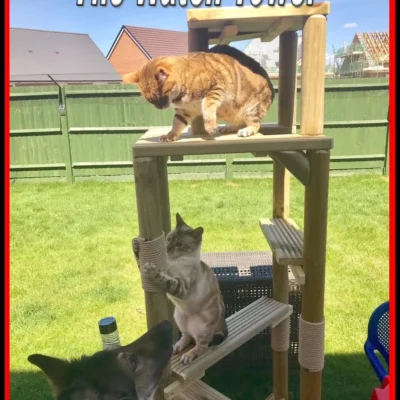
The Watch Tower
£232.00