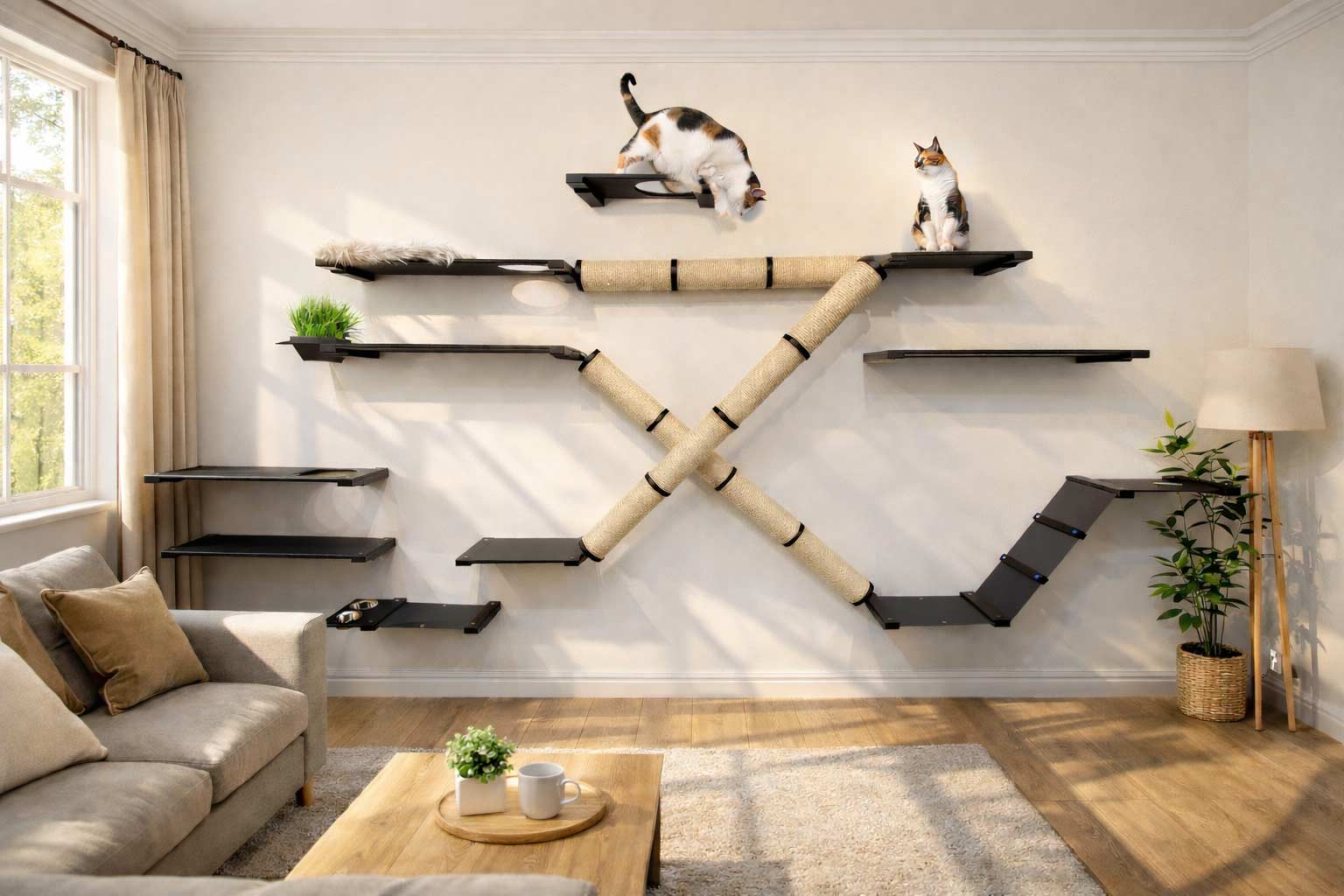
Where Is the Best Place to Put a Cat Tree? 9 Locations Cats Actually Use
The best place to put a cat tree is somewhere your cat already enjoys spending time, with a good view of the room or a secure window, enough space to climb safely and easy access without feeling trapped.
Living rooms, bedrooms, home offices and quiet window positions often work particularly well. The right location can make the difference between a cat tree becoming your cat's favourite piece of furniture and an expensive object they completely ignore.
At a glance
Put your cat tree where your cat naturally wants to be rather than hiding it in an unused corner. A stable position near a secure window or in a room where the family spends time is often ideal. Avoid unstable flooring, unsafe windows, draughty areas and locations where another pet can block your cat's route on or off the tree.
Where Is the Best Place to Put a Cat Tree?
The best location for a cat tree is usually somewhere that combines three things: security, interest and accessibility.
Cats generally do not choose resting places at random.
A favourite spot might offer a view through a window, a clear view of the room, warmth from the sun, distance from a dog or simply the ability to stay close to you without sitting directly beside you.
A cat tree positioned somewhere that already meets those preferences is much more likely to be used.
By contrast, placing a beautiful new climbing tree in an isolated spare room simply because it fits there may give your cat very little reason to visit it.
Start by watching your cat. Before deciding where your cat tree should go, notice where your cat already sleeps, watches the room, sits in sunlight and looks out of windows. Those existing preferences are often the best placement guide you have.
Gives your cat an elevated place to watch birds, people and outdoor activity while relaxing indoors.
2
In the Living Room
Lets your cat stay close to family life while choosing their own elevated resting space.
3
Near Their Favourite Sleeping Spot
Positioning the tree close to a place your cat already enjoys can make the new structure feel more relevant immediately.
4
In a Quiet Corner
A quieter position can suit nervous cats that want to observe the household without being in the centre of activity.
5
In Your Bedroom
Useful for cats that like sleeping near their owners while still having their own dedicated resting place.
6
In a Home Office
Gives your cat somewhere to supervise your working day without occupying your keyboard.
7
Where Your Cat Currently Scratches
If the tree includes sisal posts, positioning it near an existing scratching location can help redirect the behaviour.
8
In a Multi-Cat Escape Route
Vertical space can help cats avoid one another in busy or narrow areas when the structure provides several routes and perches.
9
In an Underused Vertical Space
Tall or floor-to-ceiling trees can turn a small section of floor into a much larger climbing and resting area.
1. Put a Cat Tree Near a Secure Window
A position near a window is often one of the most attractive places for a cat tree.
From an elevated perch, your cat may be able to watch birds, insects, passing people, neighbouring cats and whatever else happens outside.
For an indoor cat in particular, that changing view can add useful environmental stimulation to their day.
The important word here is secure.
Do not place climbing furniture beside an open upper-storey window, an unsecured balcony or a tilt-and-turn window that could trap your cat.
Check the window before positioning the tree.
Make sure your cat cannot use the cat tree to reach an unsafe opening. Window screens, catches and surrounding furniture should all be checked before giving your cat elevated access.
If the area receives strong direct sunlight, also make sure your cat can easily move somewhere cooler rather than being confined to one hot perch.
2. Put the Cat Tree in the Living Room
The living room is one of the best locations for many cats because it is usually where much of household life happens.
Cats often want to be near their humans without necessarily sitting on top of them.
A cat tree lets them share the room while choosing their own elevated position.
This can be particularly useful in homes with children, visitors or dogs because the cat can remain involved while creating some physical distance from floor-level activity.
Place the tree near the edge of the room rather than directly in the middle of a walkway.
A position beside a wall, window or sofa can help it feel integrated into the room while still giving your cat a useful view.
You can browse the full
CatTree cat tree collection
if you need a design that works with the amount of floor space available in your living area.
3. Position It Near a Favourite Sleeping Area
Cats are creatures of habit.
If your cat already spends every afternoon sleeping beside the radiator, on the back of the sofa or in a particular corner of the room, that preference tells you something useful.
Positioning the cat tree close to an established favourite area can make it easier for your cat to investigate and adopt.
The new tree does not necessarily need to replace their existing bed.
Instead, it can provide another level or sleeping option nearby.
This is often more successful than putting the tree in a completely unfamiliar location and expecting your cat to change their routine simply because you bought them new furniture.
4. Use a Quiet Corner for Shy or Nervous Cats
Not every cat wants to supervise a busy living room from the centre of the action.
Shyer cats may prefer an elevated resting area where they can observe the room from a little distance.
A quiet corner can work well provided it does not leave the cat trapped.
Your cat should be able to climb down and move away without another person or animal blocking their exit.
This is particularly important if the tree contains an enclosed sleeping box. A hideaway feels much less secure if another animal can sit directly outside the only entrance.
5. Put a Cat Tree in the Bedroom
If your cat regularly sleeps in your bedroom, a smaller cat tree or climbing structure can give them their own space without requiring them to occupy your pillow.
Bedrooms are often quieter than living areas and may suit cats that value undisturbed sleep.
A position near, but not directly against, the bed can provide a familiar environment with a little separation.
Make sure the tree does not block wardrobes, doors or walkways, particularly at night.
6. A Home Office Can Be an Excellent Location
If you work from home and your cat has developed a passion for sitting between you and your monitor, they may simply want to be near you.
A cat tree positioned beside your desk can create an alternative observation point.
Your cat gets your company and a good view of what you are doing, while you get slightly more room to use your keyboard.
This can work especially well with a tree that has a comfortable top platform or hammock.
7. Place It Where Your Cat Already Scratches
Many cat trees combine climbing platforms with sisal scratching posts.
If your cat currently scratches the arm of a sofa or a particular section of wall, placing an appropriate scratching surface nearby can make it easier to redirect that behaviour.
Hiding the new scratching post in another room is unlikely to be as effective if your cat has already decided that the living-room sofa is an important territorial scratching point.
You can also browse our
scratching posts
if a full cat tree is more than your cat needs in that particular area.
8. Use Cat Trees to Create Vertical Space in Multi-Cat Homes
Placement becomes even more important when several cats share a home.
Two cats living peacefully together do not necessarily want to occupy the same resting place at the same time.
Vertical space can give cats more choices about where to sit and how to move through a room.
In narrow spaces, an elevated route or tall tree can sometimes allow one cat to move away from another without a direct floor-level confrontation.
Avoid creating a dead end
In multi-cat homes, think about how a cat gets both onto and off the tree. If another cat can sit at the bottom and block the only route down, the supposedly safe high perch can become a place where your cat feels trapped.
Where possible, provide several resting locations rather than expecting multiple cats to compete for one prized top platform.
Larger households may benefit from a
large cat tree
with several generous platforms, provided the design is stable enough for the cats using it.
9. Make Use of Vertical Space in Small Homes and Flats
A lack of floor space does not necessarily mean you cannot give your cat useful climbing opportunities.
In fact, smaller homes are where vertical space can become particularly valuable.
A tall structure with a modest footprint may provide several levels of usable cat territory while occupying relatively little floor area.
A
floor-to-ceiling cat tree
can be particularly useful in rooms where you want to maximise height without filling the floor with large furniture.
Always follow the manufacturer's fitting instructions carefully and periodically check that tension fittings, wall fixings and connections remain secure.
Where Should You NOT Put a Cat Tree?
Some locations are simply less suitable, no matter how neatly the tree fits.
Directly Beside an Unsafe Window
Do not give your cat easy access to unsecured upper-floor windows, balconies or hazardous window mechanisms.
In a Busy Walkway
People repeatedly brushing past the tree can disturb resting cats and create a trip hazard.
On Uneven Flooring
A cat tree should sit firmly. Rocking or wobbling can make it less appealing and potentially unsafe.
Immediately Beside a Door
A door repeatedly opening towards the structure may startle a sleeping cat or block access.
Beside Open Fires or Intense Heat
Cats enjoy warmth, but climbing furniture should not be positioned where your cat can contact unsafe heating equipment.
Somewhere Your Cat Never Goes
An unused utility room may be convenient for you, but it may offer your cat no reason to spend time there.
Should a Cat Tree Be Near the Litter Tray?
Usually, there is little reason to position a cat tree directly beside the litter tray.
Resting, sleeping and climbing areas are generally better positioned somewhere your cat can relax and observe the home.
Litter trays should be easy to access but located somewhere your cat can toilet without feeling exposed or repeatedly disturbed.
In a large room, having both resources in the same general space may be unavoidable, but avoid crowding the sleeping platform, food, water and toilet area together in one small corner.
Should a Cat Tree Be Near Food and Water?
It does not need to be.
Your cat tree is primarily a resting, scratching, climbing and observation resource rather than a feeding station.
In many homes it makes more sense to position the tree according to where your cat wants to rest and observe, while keeping feeding and drinking areas in their own suitable locations.
Should a Cat Tree Be Against a Wall?
Many freestanding cat trees work well beside a wall because the position can feel visually secure and keeps the structure away from busy foot traffic.
However, the wall itself should not be relied upon to stabilise a tree unless the product is specifically designed to be wall-fixed.
A freestanding tree should remain stable on its own according to the manufacturer's instructions.
If the tree includes an anti-tip strap or wall fixing, use it as instructed.
For particularly large or energetic cats, stability should be prioritised over finding the most visually convenient position.
How Far Should a Cat Tree Be From the Wall?
There is no universal measurement.
Leave enough clearance for platforms, hammocks and toys to move normally and make sure your cat can climb without repeatedly hitting the wall.
Some trees are designed to sit close to a wall, while others have platforms that project in several directions.
Check the product's full assembled dimensions rather than looking only at the size of its base.
Should You Put a Cat Tree in Front of a Window?
It can be an excellent position if the window is secure.
A tree in front of or beside a window can provide a comfortable indoor observation point and make the structure more interesting to your cat.
Consider three things:
whether the window can be safely opened
whether strong direct sun could make the perch uncomfortably hot
whether outdoor cats visible through the window upset your cat
Some cats enjoy watching neighbouring cats outside. Others may become tense or frustrated when unfamiliar cats repeatedly appear close to their territory.
Your own cat's behaviour should guide whether the view is enriching or stressful.
Why Won't My Cat Use Their Cat Tree?
Placement is one of the first things to examine if your cat completely ignores a new tree.
Ask yourself what your cat gains by climbing it.
Does it offer a good view? Is it somewhere warm? Is it close to you? Does it feel stable? Can your cat get up and down easily?
A cat may avoid a tree because:
it wobbles when they jump onto it
the platforms are too small
it is positioned in an uninteresting room
another pet guards the area
the route up is difficult
the tree smells unfamiliar
your cat already has a preferred high resting place nearby
the structure is unsuitable for their age or mobility
Try changing the location before deciding that your cat simply dislikes cat trees.
How Can I Encourage My Cat to Use a New Cat Tree?
Put it somewhere your cat already visits.
Avoid starting with an isolated part of the house.
Let your cat investigate naturally.
Do not repeatedly place them onto the highest platform.
Add a familiar scent.
A favourite blanket or bed can help the tree smell less unfamiliar.
Use play to create interest.
A wand toy can encourage your cat to explore lower platforms while supervised.
Reward voluntary exploration.
An occasional treat placed on an accessible platform can create a positive association.
Check stability.
Tighten fittings and make sure the base sits completely flat.
Give it time.
Some cats claim new furniture immediately. Others may inspect it for several days before deciding it is acceptable.
Can You Move a Cat Tree Once Your Cat Uses It?
Yes, but moving it can temporarily reduce how much your cat uses it.
Once a cat tree becomes a familiar resting and scratching location, its position can become part of your cat's normal territory.
If you need to move it, a small change is generally easier than suddenly relocating it to the opposite end of the house.
Where practical, move it gradually or transfer familiar bedding with it.
A cat that ignores the tree after relocation may simply prefer the advantages of the original location.
What About Older Cats?
Older cats may still enjoy elevated places, but a location that requires several large jumps can become harder to use as mobility changes.
Place the tree where your cat can approach it easily and consider designs with:
closely spaced platforms
lower first steps
ramps
wide stable surfaces
good grip
Furniture can sometimes act as an intermediate step, but only where it creates a stable and safe route.
If your cat suddenly stops climbing or jumping when they previously did so confidently, discuss the change with your vet rather than assuming they simply no longer like their tree.
Choosing the Right Tree for the Location
Placement and design should be considered together.
Location
Useful Cat Tree Features
Living room
Attractive design, comfortable top perch, moderate footprint and good stability.
Beside a window
Elevated viewing platform or hammock with a secure, stable base.
Small flat
Tall design with a compact footprint or a properly fitted floor-to-ceiling tree.
Multi-cat home
Several platforms, multiple resting areas and enough space for cats to avoid crowding one another.
Large breed
Generous platforms, strong posts, wide base and robust construction.
Older cat
Lower first level, smaller gaps between platforms and easier routes up and down.
Existing scratching area
Large, accessible sisal scratching surfaces positioned where your cat naturally scratches.
Frequently Asked Questions
Where is the best place to put a cat tree?
The best location is somewhere your cat already spends time, ideally with an interesting view and enough room to climb safely. Living rooms and positions near secure windows work particularly well for many cats.
Should a cat tree be by a window?
A secure window can make an excellent cat-tree location because it gives your cat something interesting to watch. Make sure the window cannot create a fall, escape or trapping risk and that the perch does not become excessively hot in direct sunlight.
Should a cat tree go in the living room or bedroom?
Either can work. Choose the room your cat naturally prefers. A living room offers more opportunity to observe household activity, while a bedroom may provide a quieter sleeping environment.
Should I put a cat tree next to the litter box?
There is usually no benefit to placing them directly together. A cat tree works best as a comfortable climbing and resting area, while the litter tray should be somewhere private and easy to access.
Should a cat tree be against a wall?
Many freestanding trees work well near a wall, but they should remain stable without relying on the wall unless they are designed to be fixed to it. Always use supplied anti-tip or wall fixings where instructed.
Why won't my cat use their cat tree?
Location, stability, platform size, accessibility and competition from other pets can all affect whether a cat uses a tree. Try repositioning it somewhere your cat already enjoys before assuming they dislike the structure itself.
Can I move my cat tree to another room?
Yes, although a cat that regularly uses the tree may temporarily use it less after it is moved. Keeping familiar bedding on the tree and positioning it somewhere equally useful can make the transition easier.
Where should I put a cat tree in a small flat?
Look for an underused area beside a wall or secure window. A tall tree with a small base or a properly fitted floor-to-ceiling design can provide several levels without occupying a large amount of floor space.
Can a cat tree help in a multi-cat home?
Yes. Additional vertical resting places can give cats more choice and help them avoid one another. Ideally provide several resources and make sure one cat cannot easily block another cat's only route off the tree.
The Bottom Line
The best place for a cat tree is not necessarily the empty corner where it fits most neatly. It is the place where the tree offers something your cat actually values.
That might be a view through a secure window, a high perch in the living room, a quiet sleeping spot beside your desk or an escape route in a multi-cat household.
Watch where your cat already chooses to spend their time and use those preferences as your guide.
A stable cat tree in the right location can provide climbing, scratching, resting and observation opportunities in one piece of furniture. Put the same tree somewhere uninteresting or difficult to access and your cat may simply continue sleeping on top of the wardrobe instead.